Friday, November 4, 2016

Papa Don't Preach, or All in the (Berserker) Family, Part II

...........and now for the continuing story of Hervor the Shieldmaiden, of the House of Arngrim.

                                                                                   Berserkers Inc 
  www.complete&uttermayhem.com
                                                                                                                                Pillage R Us  
                   Our Motto is: "Maim, Murder or Marry, we do it all"
                                                                                                        Freakier by the Dozen
Arngrim & Sons, licensed to kill (bonded & insured)
Please Inquire for References


If you read my last post, then you'll know all about Hervor, posthumous daughter of Angantyr, who was one of the twelve sons of Arngrim the Berserker. The House of Arngrim was not much mourned after their collective demise, and most folks had hoped that their deeds would be left to molder in the barrow on the small island of Samsø, along with the rotting remains of Angantyr and his brothers. But Hervor had no intention of letting her inheritance rust among her father's bones. She had every intention of carrying on her family's grand tradition of fighting for plunder, and for that, she needed her father's powerful dwarf-forged sword, Tyrfing.


And that's how Hervor found herself on a viking longship, sailing for a small haunted island off of Denmark, in search of her destiny. Her crew willingly followed her to Samsø, but refused to disembark upon that fearful blood-soaked soil. Eager as they were to follow the Berserker's granddaughter into battle, they had no interest in facing the spirits of the restless dead. They left Hervor there to find her father's grave on her own. As the sun sank below the ocean horizon, tiny flames rose from the ground. The flickering ghost lights led her to the barrow she sought, solitary in that abandoned place, with only a simple runestone to marking the final resting spot of the sons of Arngrim.

Nothing daunted, Hervor faced the dark mound and summoned the spirit of Angantyr, demanding the sword which his father had given him, so that she might wield it in turn. The tiny flames along the ground shuddered, but there was no response. Impatient, Hervor called out again, less respectful but with greater urgency. She would not leave without the sword. Again, her voice resounded in silence, with nothing but the moan of the wind to answer her. Enraged and desperate, Hervor shrieked curses upon the dead, wishing eternal torture upon the decaying flesh in the lonely barrow, where her father and uncles lay. That got a response.


Out of the barrow came a weary voice, rusty from lack of use, carrying with it the stench of the grave. Angantyr had heard his daughter, but was reluctant to give up the sword whose curse had brought destruction upon their family. He pleaded with her to leave it there, and to leave the dead in peace. But Hervor would not leave empty-handed. Back and forth they argued and threatened, he reciting the curse, and she implacable in her abuse. Time seemed to slow, with nothing but the dull lights of the dead to keep her company in this spectral colloquy. Until finally, Hervor saw a pale white bone stretch out from the mound, hurling something long and glinting through the air. End over end it turned, before plunging into the dirt by her foot with a vicious thud. It was Tyrfing.


With a shout of triumph, Hervor seized her prize and called out her thanks to her father's spirit. There was no reply, but with the sword in her grip, she left the haunted place filled with excitement, eager to seek her fortune at last. Reclaiming her ship and crew, Hervor picked up where her father and grandfather had left off. True to its nature, Tyrfing could not be unsheathed without taking a life, and Hervor was well-pleased with the terror which she inspired. For years, she led her viking crew from settlement to settlement throughout northern Europe, sowing death and destruction and looting as it pleased her. In time she amassed a considerable fortune in ill-gotten goods; somewhat surprisingly, she found herself tiring of blood sport and decided to settle down.
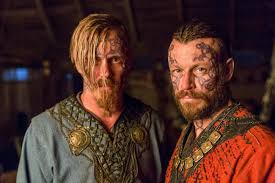
With her impressive dowry, Hervor had her pick of suitors, and she married a viking prince. She sheathed Tyrfing for the last time, and lived with her husband in peace, bearing him two sons. The elder one she named for her father, Angantyr; against all expectations, he was both handsome and well-liked, making friends easily. But Hervor's younger son, Heidrek, was quarrelsome and given to unprovoked acts of violence. Hervor's husband was fond of Angantyr, but looked with disfavor upon Heidrek. The prince had heard dark rumors of his wife's forebears and their reputation; he knew that something would have to be done about his second son, lest disaster strike the House of Arngrim once more..................


.......to be continued.......

Tuesday, November 1, 2016

All in the (Berserker) family, Part I

Last night, I hosted my first Adult Folktale Telling, at lovely Porter Square Books. It was Hallowe'en, and there's nothing like the ancient Celtic New Year to get me in the mood to tell stories. Now, for normal folks, fall's chill makes them yearn for pumpkin spice lattes and ugly Christmas sweaters. And then there's me. That nip in the air puts me in mind of some of my favorite folklore friends: The Suffocated Bride, The Little Old Woman who ate Hairy Toe Stew, the Longridge Boggart, Hoichi the Earless. Those there are my homies, and Hallowe'en doesn't pass without my paying them a visit. This year, I brought a new friend to the party, and she wasn't shy. In fact, she may have freaked out the others, and they don't scare easily.

Her name is Hervor the Shieldmaiden, and she is a Nasty Woman.

The story of Hervor is ancient, its earliest known version dating from the 12th century. Despite having been raised to be a servant and kept in ignorance of her ancestry, her bloody parentage made itself known even before she hit puberty. Given to bursts of savage violence and brutality, unusual even in Viking culture, Hervor made few friends, and her enemies feared her. Whoever told her about her lineage was probably hoping that the news would motivate her to move on. It did.

Turns out, Hervor was the posthumous daughter of Angantyr, one of the twelve sons of Arngrim, a famous Berserker. Violent mayhem was her birthright; that, and a cursed dwarf-forged sword, called Tyrfing. To a penniless orphaned bond-maiden, ownership of Tyrfing offered the promise of wealth and eternal fame, the twin lodestones of Viking culture. Neither curse nor threat of death mattered to Hervor. Only her father's sword, her rightful inheritance. (Believe it or not, Vikings were sticklers for legal niceties regarding legacies and moveable goods. Since women had higher status in Viking society than nearly anywhere else in the ancient world, they could - and did - defend their inheritance rights.) The only wrinkle in this case was that Hervor's relatives were all dead, and their weaponry, including Tyrfing, had been buried with them. But that didn't worry her.

So who were these Berserker relatives? Therein lies a
tale.... Hervor's grandfather, Arngrim, was the first in her family to claim Tyrfing, which he took from the severed hand of its first owner. This was Svafrlami (don't hurt yourself trying to say his name), one of the god Odin's numerous spawn. Odin, lord of Valhalla, was called All-Father for good reason; not even he could keep track of all of the mortal women he impregnated over the centuries, and the men and women who claimed him as their direct ancestor were legion. The luckless Svafrlami had kidnapped and forced a pair of dwarves to forge him an unbreakable, invincible sword. They complied, but in revenge they embedded a curse into the wicked blade, which caused the death of its owner, and three generations of destruction upon the House of Arngrim. In addition, the power of Tyrfing was such that whoever drew it was so overcome by bloodlust, that they felt an irresistible compulsion to kill; no drawback to a Berserker!


Proud Arngrim took Tyrfing, but he also took Svafrlami's daughter, and he fathered twelve murderous Berserker warriors on her for good measure. He amassed a fortune pillaging and terrorizing the land, before retiring in comfort and bequeathing his most prized possession to the tallest and strongest of his sons. In this way, Angantyr son of Arngrim, came to own Tyrfing. One by one, Angantyr and his brothers found and took wives; but, like their mother, few joined the House of Arngrim willingly. One of the twelve, Hjörvard, set his sights on Ingeborg, the daughter of the king of Sweden. With his eleven brothers as his wingmen, he arrived in Uppsala and announced his intention, demanding the princess. But Ingeborg already had a suitor, Hjallmar the champion of Sweden, and she was loathe to marry a Berserker. Enraged, Hjörvard challenged the Swedes and demanded the right to fight for the bride he had chosen. So Hjallmar brought a host of hundreds to meet the twelve sons of Arngrim on the small island of Samsø, off of Denmark, in a bloody battle. It was the Hunger Games, Viking Edition. Total mayhem ensued.

When it was over, the Swedes had triumphed, but just barely. Hjallmar only lived long enough to sing his own death song, but it was a song of victory nonetheless. The twelve sons of Arngrim lay mutilated and dead in a gory heap on the field of battle. The battered Swedish warriors, eager to leave the scene of slaughter, hastily covered over the gruesome corpses with the blood-soaked dirt upon which they lay. In this manner they formed a traditional warriors' barrow in which to contain the dead, whose feats of arms they grudgingly acknowledged with a runestone marking the place where the twelve Berserkers had fallen. No doubt everyone hoped that this marked the end of the reign of terror of the House of Arngrim. No such luck; as we already know, Angantyr's wife bore Hervor several months after the carnage on Samsø. Despite her attempts to keep the story of her daughter's heritage buried, along with her late unlamented husband and his cursed sword, Hervor eventually learned the truth. She somehow got her hands on a ship, recruited a crew, and sailed for Samsø, intent on claiming her inheritance. And that's when things began to get really interesting!


..........to be continued...........

Wednesday, January 20, 2016

Story Hour @ Porter Square Books


Here's a shout-out to one of my favorite places: Porter Square Books in Cambridge! Here I am, at my regular Story Hour, reading a terrific book: What Do You Do With a Tail Like This? by Steve Jenkins and Robin Page. It won a Caldecott Award, well deserved; it has beautiful and highly "readable" illustrations, and clear, informative text, as well as a section of "fine print" in the end pages, with more detailed information, for children who want to know more. A real gem of a book, I gave it 5 Stars on Goodreads.


Here I am reading Digger Man, by Andrea Zimmerman and David Clemesha, which is a good book for reading aloud, but poses a challenge, in that the language is emphatically Male Only. Luckily, reading aloud to a group of pre-literate kids, I was able to modify a couple of the words so as to make the world of trucks and diggers equally appealing to girls, as well as boys.

Wednesday, November 4, 2015

Hallowe'en Storytelling on CCTV

What a great time we all had, being filmed by CCTV for this year's Hallowe'en special! I was joined by a phenomenal lineup of Storytellers, all recruited by the inimitable Norah Dooley. Enjoy!!

https://www.cctvcambridge.org/node/354277


Spooky Storytellers: Doria Hughes - "The Big Hairy Toe" from Cambridge Community Television on Vimeo.

Tuesday, February 24, 2015

Big excitement! I'm preparing to go to Portland, OR in early March, to see three concurrent exhibitions of the work of my late grandmother, Rosemarie Beck, and to deliver a talk at Portland State University on Storytelling in relation to her work. My grandmother was an enormous inspiration to me, especially as a Storyteller, so this is a huge deal and a great opportunity. It's also a great reason to share some of her marvelous pictures on my blog, for all of you to enjoy!

Here are three paintings and one embroidery, on the theme of Antigone. These were all completed in and around 1990, which is when my grandmother was working from this this story. Typically, she depicts her characters in contemporary clothing, even though the story is from Ancient Greece.

Antigone is depicted here, flanked by her uncle, King Creon, and his son, Haemon, and her sister, Ismene.

(This one was considered a study, in preparation for a larger, more completed work)


I love the way her embroidery style mimics her brushstrokes! To see more of her embroideries, check out the current exhibit at the Oregon Jewish Museum and Center for Holocaust Education.

The Helzer Art Gallery at Portland Community College Rock Creek is also showing her work right now, including one of her embroideries.

Monday, January 21, 2013


Recently, a Storyteller friend and colleague, Tony Toledo, shared a quote by author and artist Lynda Barry with the LANES List-Serve.  (LANES is the League for Advancement of New England Storytelling.  Our List-Serve is open to anyone who is a member of LANES, and it generates a lot of great questions, discussions, revelations, etc. about Storytelling.)  

Here is what Tony, a deeply thoughtful and compassionate man, as well as a voracious reader, shared with the LANES community:

“There are certain children who are told they are too sensitive, and there are certain adults who believe sensitivity is a problem that can be fixed in the way that crooked teeth can be fixed and made straight. And when these two come together you get a fairytale, a kind of story with hopelessness in it.

I believe there is something in these old stories that does what singing does to words. They have transformational capabilities, in the way melody can transform mood.

They can't transform your actual situation, but they can transform your experience of it. We don't create a fantasy world to escape reality, we create it to be able to stay. I believe we have always done this, used images to stand and understand what otherwise would be intolerable.” 

In response to Tony’s posting this quote on the LANES List-Serve, another Storyteller responded that she was having trouble interpreting Lynda Barry’s words.  This Storyteller was worried that she was “missing something” but, probably because she knew that Tony chooses the quotes that he shares with care and thoughtfulness and therefore it was a point worth pursuing, she initiated a discussion of the meaning behind Barry’s quote amongst our community.  

Meanwhile I had been digesting the quote ever since Tony posted it, repeatedly rereading the words, which had released a flood of emotions and memories.  When the questioning Storyteller posted her query on the LANES List-Serve, I felt compelled to respond.  I had reached a point where I could no longer keep my feelings - or my wounds - to myself, and it all burst forth in my response on the LANES List-Serve.  At the suggestion of another Storyteller on the List-Serve, I have posted it here:

Lynda Barry's quote had a very powerful resonance for me.  For the first 18 years of my life, I endured unceasing bullying at the hands of my peers; bullying which was compounded by the insensitivity and misunderstanding and sheer lack of imagination of many of the adults around me, who believed that the problem stemmed from an essential character flaw within me, the person targeted for bullying.  I was given to understand in no uncertain terms that my torment would cease if I could somehow learn to not be tormented.  To them, I was a honeypot of trouble, so no wonder that flies were attracted to me; it was up to me to fundamentally change what and who I was, not for the flies to stop their buzzing.  My refusal or inability to change simply reinforced their belief that there was something wrong and bad about me.  At best I was lazy - "not trying hard enough to fix my part of the problem"; at worst, I was a truly bad person, who deserved the badness that was drawn to me.

When Barry uses the phrase "fairytale, a kind of story with hopelessness in it", I guess you could say she was being metaphorical.  If I could be so bold as to translate her words for you, I believe that she is saying that there is a kind of sad and familiar narrative (what she calls a “story” or “fairytale”) being played out among children and adults, in schools and playgrounds.  She describes the narrative as a story/fairytale because that is shorthand for saying that it is a narrative which has been reenacted over and over and over, all over the world, throughout most of recorded time.  And she calls it "hopeless", because it continues to reenact itself even today, on school playgrounds and in classrooms and in homes everywhere, despite the efforts of many to stop it.

In other words, we aren't making the kind of progress we ought to be making to ease the psychic pain of children who are "different" from their peers.  We - the grownups - are failing to recognize that the "different" kids are just as worthy of love and praise and encouragement as their peers.  We are too focused on our besetting sin as humans - the desire to be similar, to fit in, and be the same - when our true virtue and our greatest strength is our differences, and our diversity.  

The human race did not get where we are today - did not make incredible advances to improve life - by means of uniformity of thought and appearance.  We have made amazing technological, medical, and artistic breakthroughs precisely because certain individuals among us were different.  But it took more than merely being uniquely different for them to prevail; those special individuals had to fight to maintain their precious essential true selves - despite intense peer pressure to conform - so as to achieve their special destiny: discovering a new way of dressing, a new way of communicating, a new way to cure a disease.  The very qualities that cause some of us to be teased on the playground and scolded in the classroom are PRECISELY those qualities that lead to some people growing up to be Beethoven, Einstein, or Coco Chanel.  After all, what do you suppose those Difference-Makers were like as children?  You can’t imagine that they conformed to the way all the other kids behaved and thought, dutifully bending their head when the teacher taught them that 2 + 2 = 4?  Not when they knew that it sometimes equals 7.  Difference-Makers are necessarily Different.

Lynda Barry understands this narrative, has seen it play out in real life, and has made the connection between real life stories of bullied children to Stories and Fairytales, in which imaginary children suffer and try to find their way in a harsh and insensitive world.  She recognizes that Stories and Fairytales provide many of us with psychic roadmaps, or at the very least a little bit of human understanding.  They show us that we are not alone in our suffering, that other people have also been persecuted or driven away for being different.  And that sometimes those folks find their way to happy endings, if they persevere and have hope.  Have you heard of the "It Gets Better" project?  It's an on-line film project where adults record themselves telling their stories about how badly they were teased and hurt in their youth for being gay, but how they have managed to survive to a happy, or at least better, adulthood.  Their mission is to give hope, in the form of stories, to gay youth who are facing the prospect of suicide as the only way to end the misery of their current existence.

As Barry says in the quote which Tony posted, "[Stories and Fairytales] can't transform your actual situation, but they can transform your experience of it."

I could continue to explicate Barry's extraordinarily wise and very rich words, but I have to take my daughter to her bassoon lesson.  As a personal aside, I want to mention that she is the only child in her school who plays bassoon, an instrument that looks and sounds like a loudly farting bed post; in fact, she plays it in her Jazz Band, where she is the only girl in an otherwise all-male ensemble.  I am thankful every day that she embraces her own uniqueness, and fearlessly faces the world as a Jazz Bassoon-playing girl.  She knows that doing something which nobody else does is not something to be ashamed of, but something to celebrate, something which can bring joy to people around her.  It feels like a miracle to me that when she honked out her solo (her Jazz Band leader arranged Michael Jackson's "Bad" for bassoon and Jazz ensemble; he is a man with fearless intelligence and imagination) last weekend in front of a gym-full of people, with the boys in her band playing backup, it never occurred to her that anyone would put her down for who she was and what she loved.

I am thankful for the grownups like Lynda Barry and my daughter's Jazz Band leader, who understand the value of ALL children, not just the normal well-adjusted ones, but the strange and unusual ones.  All of those children have something special to give, but only if we don't crush their spirits.  And yes, stories help.  I read stories and fairytales with hungry desperation throughout my childhood, and they were a kind of solace that, as Barry says, helped me to face the harsh reality of life in the "real" world.  "We don't create a fantasy world to escape reality, we create it to be able to stay."  For those youth who have no one to turn to and cannot sustain a nurturing fantasy world in the face of intolerable cruelty, many choose not to stay with us, to our eternal loss.  Because every time we hound a “different” child from our world, we lose a Difference-Maker.  

Let’s make our world a place where all children are loved and nurtured, so that each one can grow up to surprise and delight us with their gifts.

Tuesday, October 30, 2012

Recently, I told a story.  Not a remarkable event in and of itself, given that I'd told it before, but the venue was special, and so was the event.  I had the privilege of co-hosting massmouth's very first Adult Folk Tale Slam, with massmouth co-founder and doyenne of Storytelling Norah Dooley, at the magically delicious Puppet Showplace Theater, in Brookline Village.

There are so many reasons to love PST, the Boston area's premiere spot to check out the latest in the art of puppetry. Part of my personal feeling derives from the spellbound enjoyment I experienced there as a wee tot, on the rare occasions when my parents brought me in to town for a show. Utter joy, to see some of my favorite stories enacted before my eyes on a small stage, by beautiful little creatures, operated as if by magic, by clever characters in black gloves.  Years later, I had the distinct pleasure of bringing my own child to a show, and reliving that enchanting experience.
So it felt like coming full circle, to stand on that stage all by myself, and tell a story, acting as my own full-sized homunculus, string-free and slap-happy, as I regaled the audience with "The Laziest Lass in All Ireland." Our theme for this first Adult Folk Tale Slam was "Grimm & Twisted," in homage to the bicentennial of the publication of the Grimm brothers' famous collection of Folk Tales.  (If you're interested in massmouth's Adult Folk Tale Slams, you can click here for more information.)  The story I told is an Irish variant of a Grimm tale, known in their collection as "The Three Spinners."

I like this story, in part, because it is about fiber arts, and I'm an avid knitter.  It starts with a young woman who hates to spin, and won't take part in any of the work around her home.  She's a daydreamer, and if she had known how to read, she would most likely have been an unrepentant bookworm, like myself.  In short order, the heroine of the story finds herself in a large room filled with flax that needs spinning.  This is about where you'd expect someone like Rumpelstiltskin to show up, and make her an offer she can't refuse, if you know what I mean, but instead a cheerful and peculiarly deformed small woman - of obvious fairy extraction - appears, and does the spinning for her, in exchange for nothing more than an invitation to the heroine's wedding feast, which is anticipated with confidence.

This being a fairytale, of course there are a total of three visitations made by three mysteriously misshapen fairy females; the twist at the end comes when our heroine actually fulfills her obligation to her three helpers, against all expectation.  This rather shocked me when I first read this tale, since throughout the story, the young woman is portrayed rather unsympathetically; I confess that my expectations of her moral and intellectual fiber were pretty low.  It really took me by surprise when she actually follows through on her promises and allows these three strange looking creatures to attend her wedding feast.

Other than being pretty, the heroine has no noticeable appeal - no interesting character traits or talents - apart from a marked propensity to indulge in histrionics when things don't go her way.  You can't help but wonder, why do those three little ladies take such pains to help her out?  This question remains unanswered for the bulk of the story, but the threesome come through for the unnamed heroine, with the result that the prince of Ireland marries a seemingly worthless bride - or so she is in the eyes of his mother, who is a noted spinner and craftswoman.  When her rescuers do show up to her wedding feast, they pose as her aunts, and sit in places of honor at the high table with the bridal party.  As a result of their acceptance to this company, they take it upon themselves to cleverly bestow yet another extraordinary gift upon their purported niece, perhaps the most precious of all, at least to her.  (Read the story here to find out!)

My interpretation is, that the bride will win her mother-in-law over in the end, not because she is talented or diligent, but because she is well-endowed with powerful and magical family members (even if they are not related by blood).  Even more, our heroine reveals herself as a person who keeps her promises, and who honors the people who help her achieve her heart's desire.  Perhaps her innately honorable nature is what attracted her "aunts" in the first place?

An unusual moral for an unusual story, for it is not hard work and perseverance that wins the day here, as so often in Grimm tales.  Instead, loyalty and gratitude are rewarded and celebrated.  Sometimes it pays to be well-connected!